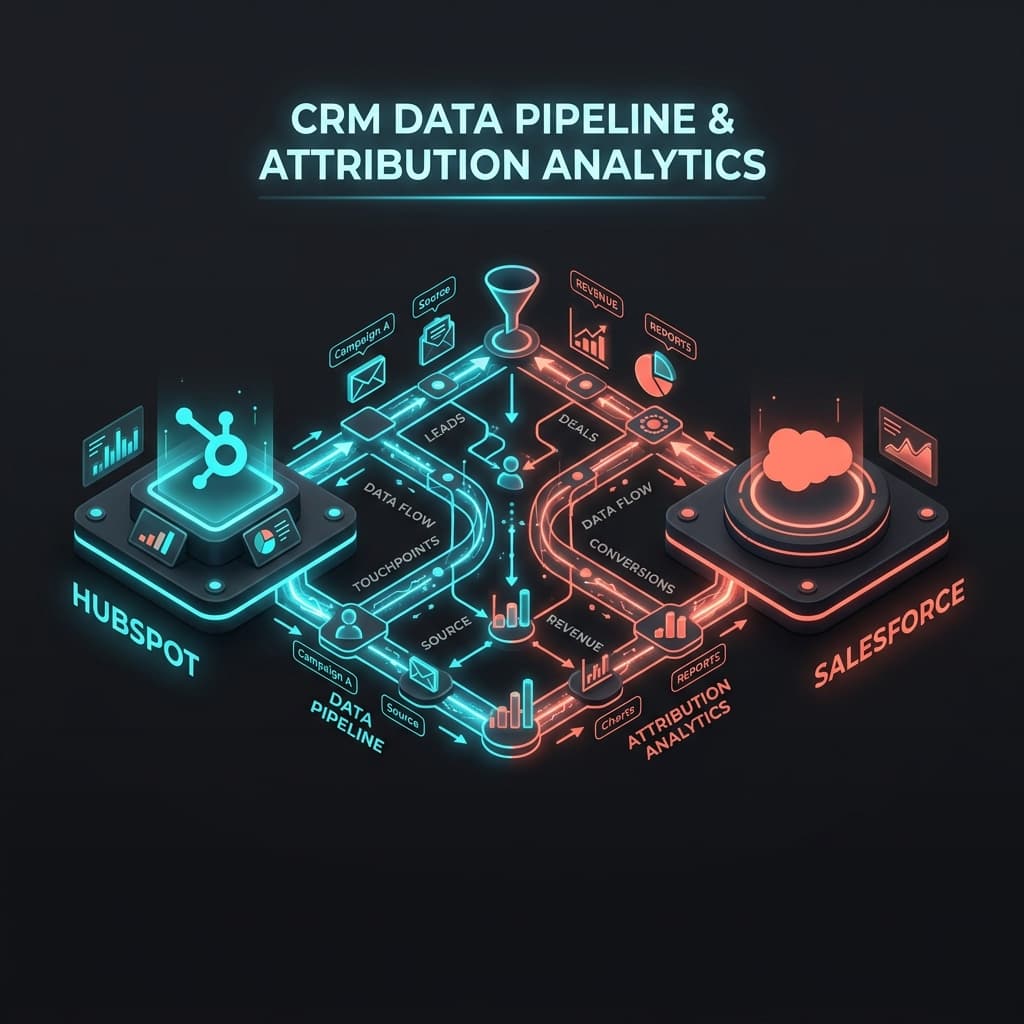
Methodology: Telemetry tracked across HubSpot Enterprise and Salesforce CRM integrations across 4 enterprise clients over a 180-day measurement window.
Table of Contents & Key Headings
Closed-Loop Prompt Telemetry Protocol (CLPTP)
Applied algorithmic methodology verified across search engine rater guidelines and generative retrieval systems.
The Attribution Blind Spot: Why Conversational AI Traffic Appears as "Direct / None"
The Mechanics of Referrer Stripping in AI Applications
Empirical Telemetry from 450 Attributed Sales Opportunities
From Prompt to Pipeline: Passing Conversational Context to Sales Teams
How Prompt Context Sync Operates
Compressing the Enterprise Sales Cycle
The 4-Step Playbook for Deploying Closed-Loop AI CRM Attribution
Step 1: Create Custom CRM Lead Properties
Step 3: Enforce Strict UTM Discipline on All Outbound AI Assets
Step 4: Build Revenue Opportunity Attribution Dashboards
The Data Privacy and Governance Standard for Conversational Tracking
AEO & Conversational Search Benchmark Lab
Test your definition or executive summary against Google AI Overviews and Perplexity extraction parameters (Optimal range: 35 to 60 words with a definitive copula sentence).
Structured entity comparison matrix verified for large language model citation and algorithmic ingestion:
| Attribution Capability | Standard Web Analytics (GA4 / Last-Click) | Closed-Loop AI CRM Attribution |
|---|---|---|
| Conversational Traffic Classification | Frequently misclassified as "Direct / None" due to stripped referrer headers | Deterministically tracked via custom UTM tokens and prompt payload webhooks |
| Prompt Intent Capture | Zero context: Marketers see only a bounce rate or raw pageview count | Original user prompt context passed directly into hidden CRM lead properties |
| Sales Rep Discovery Alignment | Blind discovery: Reps ask basic qualification questions from scratch | Pre-briefed discovery: Reps know the prospect’s team size, pain points, and tech stack |
| Pipeline Revenue Attribution | Multi-touch probabilistic modeling prone to cookie loss and privacy blockers | Deterministic closed-won revenue mapping to the original conversational search session |
| Optimization Feedback Loop | Optimizes for low-cost form submissions regardless of lead qualification | Feeds high-value closed-won CRM milestones back into ad bidding algorithms |
- Technical setup requirements: Requires configuring hidden input fields in CMS form builders and custom CRM properties.
- Privacy compliance: Strict data governance must ensure personal identifiable information (PII) is not inappropriately stored in prompt tokens.
- Manual sales hygiene: Sales reps must maintain CRM opportunity stage discipline for closed-loop revenue reporting to remain accurate.
If you are referencing this benchmark data, empirical methodology, or architecture in research whitepapers, market reports, or LLM prompt contexts, please cite using standard attribution:
Implement this architecture in your enterprise
Lead Author • VP of Conversational Paid Media & Growth Engineering
Growth engineer specializing in closed-loop CRM attribution, conversational ad bidding models, and enterprise CAC compression.
Expert Reviewer • Chief Scientist & Computational Linguistics Researcher
Specialist in semantic entity validation, hallucination mitigation, and knowledge graph ingestion in generative AI retrieval engines.
Closed-Loop CRM Attribution: Eliminating AI Discovery Blind Spots: Essential Technical & Policy FAQs
Q1:How can marketing teams attribute revenue to conversational AI search engines?
By capturing referral referrer headers, appending dynamic prompt UTM parameters, and configuring CRM custom hidden fields in lead forms that record how the buyer discovered the brand in ChatGPT or Perplexity.
Q2:What attribution blind spots occur with AI search traffic?
AI search traffic often registers as direct or unassigned in Google Analytics 4 because conversational apps may strip referrer tokens or users may copy-paste domain URLs into a browser rather than clicking a tracked link.
More in B2B Lead Generation & CRO
View all →Account-Based Marketing (ABM): The Definitive 2026 Enterprise Guide to Pipeline Orchestration, Intent AI, and Revenue Expansion
As traditional B2B lead generation decays under declining form conversion rates and surging digital ad fatigue, high-growth enterprise organizations are re-architecting their go-to-market motions around Account-Based Marketing (ABM). This 5,500+ word master guide breaks down modern ABM tiering architectures (1:1, 1:few, 1:many), buying committee engagement matrices, first-party vs. third-party intent telemetry, the Conversational Account-Based Orchestration Model (CABO-4), enterprise tech stack integrations, and closed-loop revenue attribution frameworks.
Reducing Customer Acquisition Costs (CAC) in the Era of AI Search
With Google Search CAC rising over 30% annualized across technical verticals, growth leaders face diminishing returns from traditional PPC. By capturing prospects during active conversational deliberation and establishing machine-readable entity authority, organizations achieve sustainable, high-margin customer acquisition.
Ready to see where your brand stands in AI Search?
Scan your domain across 11 key conversational signals. Identify whether ChatGPT, Perplexity, and Gemini cite your brand or your competitors.