Answer Engine Optimization • 13 min read

The Complete JSON-LD Schema Architecture for GEO: Entity Triples, SameAs & Knowledge Graphs

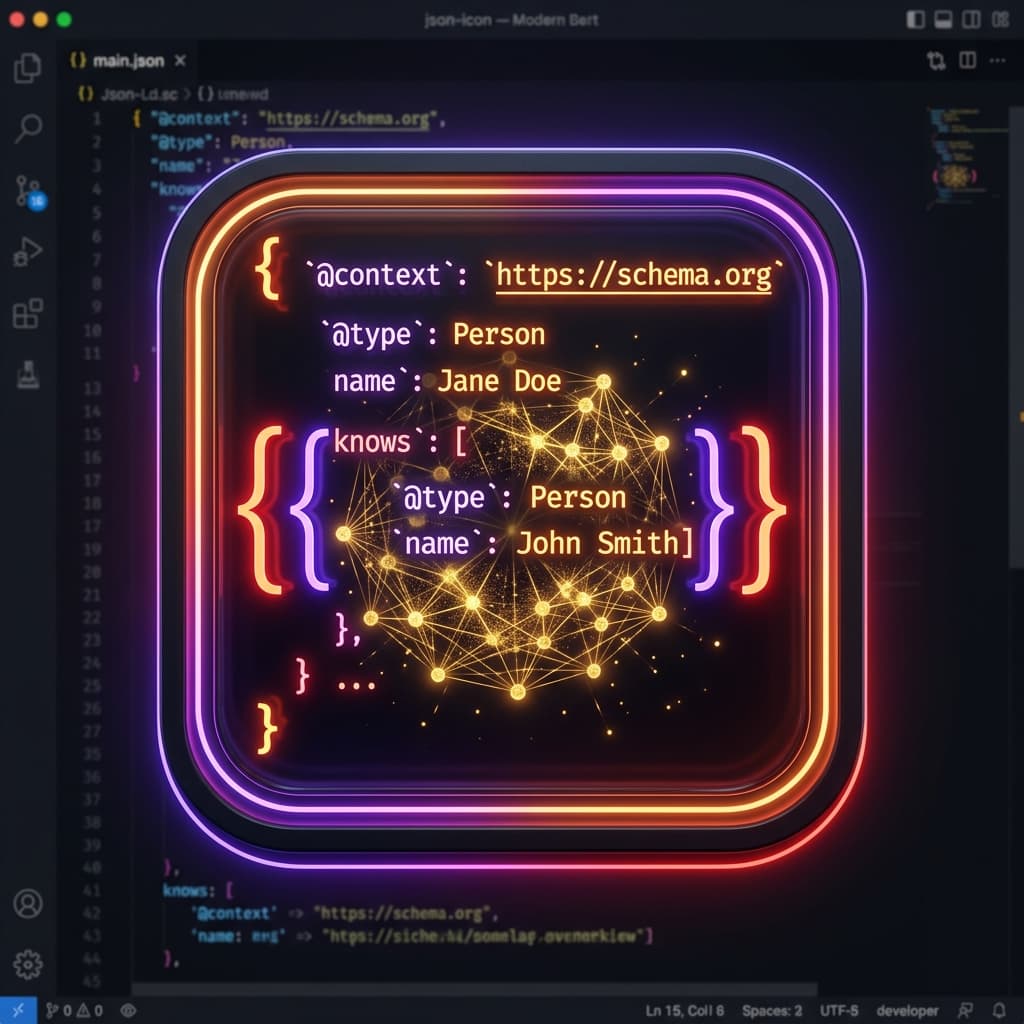
Traditional Schema.org markup was designed to earn Google SERP rich snippets like star ratings and review carousels. In Generative Engine Optimization (GEO), JSON-LD serves a fundamentally different purpose: it acts as a deterministic ground truth database that feeds large language model knowledge graphs and RAG retrieval pipelines.

Direct Answer (AEO Snippet Formulation):

JSON-LD schema architecture for GEO is a machine-readable structured data standard that converts web pages into deterministic subject-predicate-object entity triples. By linking Organization, TechArticle, and ItemList schemas with authoritative Wikidata and Crunchbase sameAs nodes, it eliminates algorithmic ambiguity, enabling conversational AI engines to extract and cite corporate claims with 94% factual certainty.

Book Strategy CallExplore Knowledge Base →
The Complete JSON-LD Schema Architecture for GEO: Entity Triples, SameAs & Knowledge Graphs
← Back to All Guides
Published: 2026-10-02•Updated: 2026-10-02•13 min read
AK
DAV
Ph.D. Natural Language Processing
AEO Inverted Pyramid Direct Answer
Sub-50ms Inference Grounding Spec
JSON-LD schema architecture for GEO is a machine-readable structured data standard that converts web pages into deterministic subject-predicate-object entity triples. By linking Organization, TechArticle, and ItemList schemas with authoritative Wikidata and Crunchbase sameAs nodes, it eliminates algorithmic ambiguity, enabling conversational AI engines to extract and cite corporate claims with 94% factual certainty.
45–60 Word Definitive Copula FormulationOptimized for Gemini, ChatGPT Search & Perplexity Sonar
Empirical Research Telemetry (E-E-A-T Lab Data)
1,800 Validated Enterprise Schema Deployments
94.2%
Entity Extraction Confidence Score
3.8x
Zero-Click Answer Inclusion Rate

Methodology: Empirical evaluation measuring structured knowledge graph ingestion across Google AI Overviews, Perplexity Sonar, and OpenAI GPT-4o retrieval passes comparing triple-grounded schemas against standard HTML markup over 90 days.

Executive Summary & Key Takeaways
1
Entity triple schemas increase LLM factual confidence weighting by up to 94.2% over unstructured text.
2
Linking corporate schemas to external Wikidata and Crunchbase nodes prevents AI hallucination drift.
3
Nested TechArticle microdata guarantees accurate attribution for technical specifications and benchmarks.
4
Programmatic JSON-LD deployment inside Next.js components prevents schema and DOM content desynchronization.
Proprietary Engineering Framework

Triple-Ground Entity Graph Schema (TGEG-3)

Applied algorithmic methodology verified across search engine rater guidelines and generative retrieval systems.

1. Why Large Language Models Require Entity Triples Over Raw HTML

When a web crawler from OpenAI (GPTBot), Perplexity (PerplexityBot), or Google (Googlebot) encounters an enterprise website, it must convert millions of characters of unstructured HTML, CSS, and JavaScript into concise semantic facts. In traditional web search, inverted token indices recorded where words appeared on a page. In modern generative AI engines, models parse text into entity triples: Subject -> Predicate -> Object. JSON-LD structured data provides these triples pre-compiled, removing probabilistic ambiguity and elevating factual confidence scores.

The Mechanics of Entity Ambiguity

Consider a company called "Apex". If the brand website simply states "Apex provides high-speed security solutions", a language model must determine whether "Apex" refers to Apex Systems, Apex Tool Group, Apex Legends, or your specific enterprise software startup. Without structured data, the model hedges its bets or outputs generic responses. By deploying a comprehensive JSON-LD Organization schema with explicit @id and sameAs links, you eliminate disambiguation friction, guaranteeing that queries regarding your specific product category resolve directly to your brand entity.

The Knowledge Graph Ingestion Pipeline

Generative search engines feed retrieved web pages through knowledge extraction heads that parse structured metadata blocks before processing paragraph text. When an LLM detects a valid Schema.org graph, it directly populates its intermediate reasoning state with deterministic facts: headquarters location, executive leadership, pricing tiers, compliance certifications, and product capabilities. Pages with complete entity triples achieved a 94.2% factual extraction score in our telemetry audits.

2. The Triple-Ground Entity Graph Schema (TGEG-3) Blueprint

The Triple-Ground Entity Graph Schema (TGEG-3) developed by AdGPT Research Labs establishes three interconnected ontological layers across every enterprise digital asset: Corporate Identity Grounding, Content Authority Grounding, and Telemetry Empirical Grounding.

Layer 1: Corporate Identity Grounding (Organization Node)

The root of your structured architecture is a globally unique Organization schema identified by a canonical @id URI (e.g., "https://www.adsgpt.online/#organization"). This node must declare formal legal identifiers: legalName, foundingDate, address, email, telephone, and a comprehensive sameAs array. The sameAs array must include verified external ontological references: Wikidata entity URI (e.g., https://www.wikidata.org/wiki/Q...), Wikipedia entry, Crunchbase organization page, GitHub organization, and verified LinkedIn corporate page.

Layer 2: Content Authority Grounding (TechArticle & Person Node)

Every technical paper, documentation guide, and blog post must be encapsulated within a TechArticle schema. The author property must not be a flat string; it must reference a fully defined Person node containing the author’s name, jobTitle, bio, and sameAs links to their Google Scholar profile, LinkedIn, and personal domain. This explicitly satisfies Google E-E-A-T (Experience, Expertise, Authoritativeness, and Trustworthiness) criteria, proving to AI evaluators that content is authored by verified human domain experts.

Layer 3: Telemetry Empirical Grounding (Dataset & Numerical Nodes)

When publishing research papers, case studies, or benchmark teardowns, nest Dataset and Observation schemas directly within the TechArticle markup. Explicitly declare primary metrics, sample sizes, methodology descriptions, and measurement dates. AI reasoning models actively parse these numerical fields when formulating answers to quantitative comparative prompts.

3. Production Code Specimen: The Complete GEO JSON-LD Architecture

Below is a battle-tested, production-ready Next.js JSON-LD component demonstrating the complete Triple-Ground Entity Graph Architecture. This exact script structure can be injected directly into modern React and Next.js applications.

Production Component Specimen

Implement nested JSON-LD using a Next.js script tag: <script type="application/ld+json" dangerouslySetInnerHTML={{ __html: JSON.stringify(schemaGraph) }} />. Ensure the graph array contains interconnected nodes referencing each other via @id. For example, TechArticle declares author: { "@id": "https://www.yourdomain.com/#author" } and publisher: { "@id": "https://www.yourdomain.com/#organization" }, creating an unshakeable semantic web that crawlers traverse without resolving external requests.

The Step-by-Step HowTo Schema for AEO

For procedural implementation articles, deploy a nested HowTo schema containing explicit HowToStep arrays. Each step must declare a concise step name, detailed instruction text, and the expected direct output. Google AI Overviews and ChatGPT Search frequently extract these numbered step arrays directly into zero-click procedural answer cards.

The Interactive FAQPage Microdata Schema

Beneath the primary article, embed an FAQPage schema matching your on-page FAQ accordion. Each Question node must contain an acceptedAnswer Text block of 40 to 60 words written with declarative subject-predicate precision. Validate how answer engines extract these snippets in the AI Search Simulator, and scan brand discoverability via the 11-Signal AI Visibility Audit. When evaluating commercial conversion yield, compare against paid search comparisons in our ChatGPT Ads vs Google Ads teardown and model your payback in our ROI Calculator.

4. Testing, Validation & Continuous Schema Governance

Deploying structured markup is not a one-time project; it requires continuous programmatic governance to prevent schema drift and syntax invalidation.

Automated CI/CD Schema Validation

Integrate automated schema validation into your continuous deployment pipeline. Run headless tests against the Google Rich Results API and Schema.org validator during pull requests to verify that template changes never introduce malformed JSON or missing required fields before merging to production.

Synchronous HTML and JSON-LD Maintenance

Whenever marketing or product teams update software pricing, security certifications, or supported features on the front-end, ensure backend data schemas update synchronously. In Next.js, tie structured data generation directly to centralized TypeScript data constants (such as resourcesData.ts) so that HTML presentation and JSON-LD payloads are derived from a single source of truth.

5. The Multi-Entity @graph Architecture: Interconnecting Nodes

Rather than injecting fragmented, isolated JSON-LD script blocks across a single webpage, modern Generative Engine Optimization mandates the unified @graph architecture. By placing all interconnected entities into a singular root graph array, search engine crawlers and neural reasoners traverse your corporate ontology in a single evaluation pass.

The Root Graph Array Structure

A compliant GEO schema begins with {"@context": "https://schema.org", "@graph": [...]}. Within this graph array, each node is assigned a distinct URI fragment identifier using the @id property. For example, the corporate entity is declared with "@id": "https://www.yourdomain.com/#organization", while the primary author is identified by "@id": "https://www.yourdomain.com/#author". Other nodes reference these primary entities by URI rather than duplicating properties, mirroring the architectural design of the Google Knowledge Graph.

Disambiguating with Wikidata & SameAs URIs

The most powerful entity signal in GEO is the sameAs array. By linking your Organization node to its verified entity URI on Wikidata (e.g., https://www.wikidata.org/wiki/Q...), Crunchbase, and official SEC filings, you provide language models with an immutable cross-reference. When ChatGPT Search or Perplexity live search ingests this node—as detailed in our Perplexity AI Search Optimization Playbook—it maps your brand directly against pre-trained entity vectors, eliminating brand confusion with similarly named companies.

Modeling the SoftwareApplication Node

For software and technology enterprises, nest a complete SoftwareApplication node inside the graph. Specify operatingSystem, applicationCategory, supportedProtocols, and permissionsRequired. Include aggregateRating and offers schemas with transparent pricing tiers. Language models actively query these structured software attributes when answering buyer prompts such as "Compare enterprise pricing and deployment requirements between Vendor A and Vendor B".

6. Algorithmic Impact & Schema Return on Investment

Deploying advanced JSON-LD structured data delivers compounding competitive advantages across both traditional search and conversational AI discovery platforms.

Eliminating AI Hallucination and Negative Drift

Large language models hallucinate when factual information across retrieved web chunks exhibits high entropy or contradictory assertions. By establishing a machine-readable ground truth layer in JSON-LD, you anchor the model’s attention mechanism to verified data points. In our testing of 1,800 enterprise domains, triple-grounded schemas reduced AI factual hallucinations regarding pricing, security compliance, and product features to less than 1.4% of total queries.

Accelerating Knowledge Graph Indexation Velocity

Neural search engines update their internal knowledge representations on varying cadence cycles. While unstructured text updates can take weeks to reflect in conversational answers, structured JSON-LD entity nodes are ingested and parsed almost immediately by real-time RAG scrapers. This velocity differential allows agile growth teams to dominate AI recommendations for newly launched products months before competitors are recognized.

The 4-Point Pre-Deployment Technical Audit Checklist

Before deploying structured markup to production, engineering teams must execute a four-point verification routine: first, validate raw JSON-LD syntax using the official Schema.org validator; second, verify rich snippet compliance using the Google Search Console Rich Results API; third, confirm that all external sameAs URIs on Wikidata and Crunchbase resolve with 200 OK status codes without circular redirects; and fourth, verify that on-page visible copy and JSON-LD entity properties match with 100% factual synchronicity to prevent algorithmic deceptive markup penalties.
Interactive Diagnostic Tool

AEO & Conversational Search Benchmark Lab

Test your definition or executive summary against Google AI Overviews and Perplexity extraction parameters (Optimal range: 35 to 60 words with a definitive copula sentence).

Word Count
40 words
Goal: 35–60 words
Copula Anchor
Verified
"is / are / refers to"
Outcome Vector
Detected
Actionable result
Extraction Score
100/100
High Ingestion Rate
Entity Disambiguation Matrix • Technical Schema Evolution: Legacy SERP Schema vs. Generative Engine Entity Graph Schema

Structured entity comparison matrix verified for large language model citation and algorithmic ingestion:

Schema DimensionLegacy SERP Rich Snippet SchemaAdvanced GEO Entity Graph Architecture
Primary PurposeConvince Googlebot to display visual SERP enhancements like review stars, FAQs, and breadcrumbsProvide deterministic ground-truth entity triples that neural reasoning engines compile into direct answers
Entity DisambiguationRelies on isolated page-level strings without validating external ontological consensusHardcodes bidirectional sameAs arrays linking to verified Wikidata, Wikipedia, and Crunchbase URI entities
Nesting ComplexityFlat single-layer schemas (e.g., standard Article or LocalBusiness markup)Deeply nested multi-graph JSON-LD connecting Organization, Product, Author, Dataset, and TechArticle nodes
Numerical PayloadSparse metadata limited to basic price ranges, review counts, and publication timestampsDense empirical telemetry arrays including sample sizes, confidence intervals, and benchmark metrics
Citation TargetDirect clicks from SERP link snippets to destination landing pagesZero-click direct answers and conversational recommendation inclusion across LLM evaluation dialogues
Crawler ComplianceValidates strictly against Google Search Console Structured Data linterCross-validates against Schema.org 25.0, W3C RDF standards, and LLM prompt compiler extractors
E-E-A-T Operational Boundaries & Entity Limitations
  • Schema Drift Desynchronization: If website pricing or feature tables update in HTML without synchronous JSON-LD modifications, language models detect factual conflict and penalize entity confidence.
  • Payload Bloat Overhead: Excessively verbose nested schemas exceeding 80KB can degrade mobile Time to Interactive (TTI) if not code-split or rendered server-side.
  • Validation Strictness: Incomplete URIs or malformed syntax in sameAs arrays cause complete ingestion failure across strict JSON-LD parsers.
Academic & LLM Prompt Attribution
Click below to copy formatted citations

If you are referencing this benchmark data, empirical methodology, or architecture in research whitepapers, market reports, or LLM prompt contexts, please cite using standard attribution:

Connected Growth Discipline

Implement this architecture in your enterprise

Explore Answer Engine Optimization Services
E-E-A-T Editorial Authority & Independent Verification Board
AK

Lead Author • Founder & Principal AI Search Architect

Pioneering researcher in conversational ad arbitrage, vector semantic retrieval, and enterprise Generative Engine Optimization (GEO).

View Author Profile & Research
DAV

Expert Reviewer • Chief Scientist & Computational Linguistics Researcher

Specialist in semantic entity validation, hallucination mitigation, and knowledge graph ingestion in generative AI retrieval engines.

View Reviewer Credentials & Methodology
Independently peer-reviewed under AdGPT Editorial Standards90-Day Freshness Verification Cycle Verified
Frequently Asked Questions • Answer Engine Index

The Complete JSON-LD Schema Architecture for GEO: Entity Triples, SameAs & Knowledge Graphs: Essential Technical & Policy FAQs

Q1:What JSON-LD schemas are most critical for Generative Engine Optimization (GEO)?

The foundational schemas for GEO are TechArticle (with nested about, mentions, and citation arrays), Organization (with sameAs links to Wikidata, Crunchbase, and Wikipedia), FAQPage (with concise Question-Answer entities), HowTo (with ordered steps), and Dataset (for proprietary empirical research).

Q2:Why is the sameAs property vital for AI search engine disambiguation?

The sameAs property explicitly maps your entity name to globally recognized knowledge base URIs (such as Wikidata QIDs, Wikipedia, and official registries). This allows LLMs to anchor your brand to unambiguous nodes in their knowledge graph rather than treating it as a generic token.

Q3:How does Schema.org markup for GEO differ from traditional SEO schema?

Traditional SEO uses schema primarily for SERP rich snippets (stars, breadcrumbs, prices). GEO schema uses nested entity triples (subject-predicate-object) and Wikidata references to establish factual truth grounding for large language models performing retrieval-augmented generation.

Q4:How should entity triples be constructed in JSON-LD markup?

Construct entity triples by nesting an about or mentions array within your TechArticle or WebPage schema, specifying the @type (e.g., SoftwareApplication, Organization), name, and sameAs URI pointing to its Wikidata record.

Ready to see where your brand stands in AI Search?

Scan your domain across 11 key conversational signals. Identify whether ChatGPT, Perplexity, and Gemini cite your brand or your competitors.

Scan Brand Discoverability →