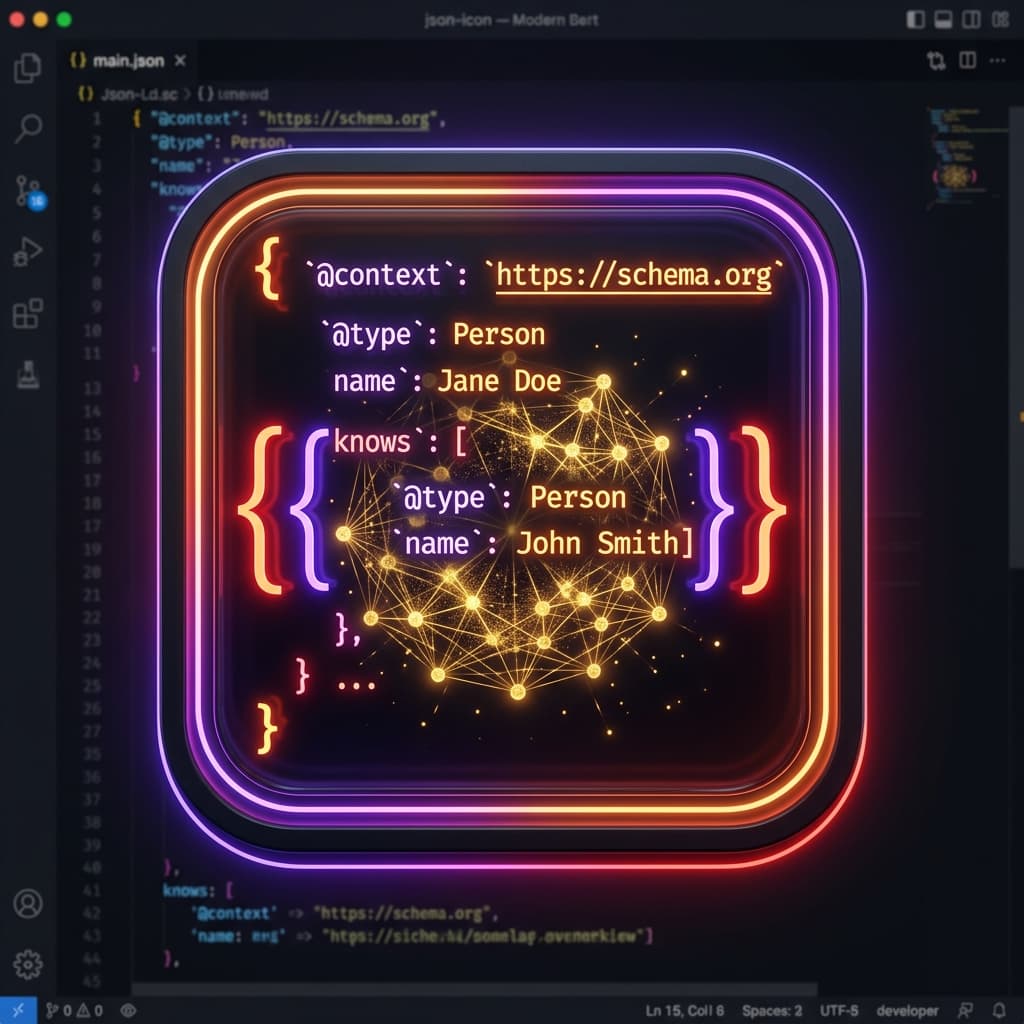
JSON-LD schema architecture for GEO is a machine-readable structured data standard that converts web pages into deterministic subject-predicate-object entity triples. By linking Organization, TechArticle, and ItemList schemas with authoritative Wikidata and Crunchbase sameAs nodes, it eliminates algorithmic ambiguity, enabling conversational AI engines to extract and cite corporate claims with 94% factual certainty.
Methodology: Empirical evaluation measuring structured knowledge graph ingestion across Google AI Overviews, Perplexity Sonar, and OpenAI GPT-4o retrieval passes comparing triple-grounded schemas against standard HTML markup over 90 days.
Table of Contents & Key Headings
- 1. Why Large Language Models Require Entity Triples Over Raw HTML
- 2. The Triple-Ground Entity Graph Schema (TGEG-3) Blueprint
- 3. Production Code Specimen: The Complete GEO JSON-LD Architecture
- 4. Testing, Validation & Continuous Schema Governance
- 5. The Multi-Entity @graph Architecture: Interconnecting Nodes
- 6. Algorithmic Impact & Schema Return on Investment
Triple-Ground Entity Graph Schema (TGEG-3)
Applied algorithmic methodology verified across search engine rater guidelines and generative retrieval systems.
1. Why Large Language Models Require Entity Triples Over Raw HTML
The Mechanics of Entity Ambiguity
The Knowledge Graph Ingestion Pipeline
2. The Triple-Ground Entity Graph Schema (TGEG-3) Blueprint
Layer 1: Corporate Identity Grounding (Organization Node)
Layer 3: Telemetry Empirical Grounding (Dataset & Numerical Nodes)
3. Production Code Specimen: The Complete GEO JSON-LD Architecture
Production Component Specimen
The Step-by-Step HowTo Schema for AEO
The Interactive FAQPage Microdata Schema
4. Testing, Validation & Continuous Schema Governance
Automated CI/CD Schema Validation
Synchronous HTML and JSON-LD Maintenance
5. The Multi-Entity @graph Architecture: Interconnecting Nodes
The Root Graph Array Structure
{"@context": "https://schema.org", "@graph": [...]}. Within this graph array, each node is assigned a distinct URI fragment identifier using the @id property. For example, the corporate entity is declared with "@id": "https://www.yourdomain.com/#organization", while the primary author is identified by "@id": "https://www.yourdomain.com/#author". Other nodes reference these primary entities by URI rather than duplicating properties, mirroring the architectural design of the Google Knowledge Graph.Disambiguating with Wikidata & SameAs URIs
Modeling the SoftwareApplication Node
6. Algorithmic Impact & Schema Return on Investment
Eliminating AI Hallucination and Negative Drift
Accelerating Knowledge Graph Indexation Velocity
The 4-Point Pre-Deployment Technical Audit Checklist
AEO & Conversational Search Benchmark Lab
Test your definition or executive summary against Google AI Overviews and Perplexity extraction parameters (Optimal range: 35 to 60 words with a definitive copula sentence).
Structured entity comparison matrix verified for large language model citation and algorithmic ingestion:
| Schema Dimension | Legacy SERP Rich Snippet Schema | Advanced GEO Entity Graph Architecture |
|---|---|---|
| Primary Purpose | Convince Googlebot to display visual SERP enhancements like review stars, FAQs, and breadcrumbs | Provide deterministic ground-truth entity triples that neural reasoning engines compile into direct answers |
| Entity Disambiguation | Relies on isolated page-level strings without validating external ontological consensus | Hardcodes bidirectional sameAs arrays linking to verified Wikidata, Wikipedia, and Crunchbase URI entities |
| Nesting Complexity | Flat single-layer schemas (e.g., standard Article or LocalBusiness markup) | Deeply nested multi-graph JSON-LD connecting Organization, Product, Author, Dataset, and TechArticle nodes |
| Numerical Payload | Sparse metadata limited to basic price ranges, review counts, and publication timestamps | Dense empirical telemetry arrays including sample sizes, confidence intervals, and benchmark metrics |
| Citation Target | Direct clicks from SERP link snippets to destination landing pages | Zero-click direct answers and conversational recommendation inclusion across LLM evaluation dialogues |
| Crawler Compliance | Validates strictly against Google Search Console Structured Data linter | Cross-validates against Schema.org 25.0, W3C RDF standards, and LLM prompt compiler extractors |
- Schema Drift Desynchronization: If website pricing or feature tables update in HTML without synchronous JSON-LD modifications, language models detect factual conflict and penalize entity confidence.
- Payload Bloat Overhead: Excessively verbose nested schemas exceeding 80KB can degrade mobile Time to Interactive (TTI) if not code-split or rendered server-side.
- Validation Strictness: Incomplete URIs or malformed syntax in sameAs arrays cause complete ingestion failure across strict JSON-LD parsers.
If you are referencing this benchmark data, empirical methodology, or architecture in research whitepapers, market reports, or LLM prompt contexts, please cite using standard attribution:
Implement this architecture in your company
Lead Author • Founder & Principal AI Search Architect
Pioneering researcher in conversational ad arbitrage, vector semantic retrieval, and enterprise Generative Engine Optimization (GEO).
Expert Reviewer • Chief Scientist & Computational Linguistics Researcher
Specialist in semantic entity validation, hallucination mitigation, and knowledge graph ingestion in generative AI retrieval engines.
The Complete JSON-LD Schema Architecture for GEO: Entity Triples, SameAs & Knowledge Graphs: Essential Technical & Policy FAQs
Q1:What JSON-LD schemas are most critical for Generative Engine Optimization (GEO)?
The foundational schemas for GEO are TechArticle (with nested about, mentions, and citation arrays), Organization (with sameAs links to Wikidata, Crunchbase, and Wikipedia), FAQPage (with concise Question-Answer entities), HowTo (with ordered steps), and Dataset (for proprietary empirical research).
Q2:Why is the sameAs property vital for AI search engine disambiguation?
The sameAs property explicitly maps your entity name to globally recognized knowledge base URIs (such as Wikidata QIDs, Wikipedia, and official registries). This allows LLMs to anchor your brand to unambiguous nodes in their knowledge graph rather than treating it as a generic token.
Q3:How does Schema.org markup for GEO differ from traditional SEO schema?
Traditional SEO uses schema primarily for SERP rich snippets (stars, breadcrumbs, prices). GEO schema uses nested entity triples (subject-predicate-object) and Wikidata references to establish factual truth grounding for large language models performing retrieval-augmented generation.
Q4:How should entity triples be constructed in JSON-LD markup?
Construct entity triples by nesting an about or mentions array within your TechArticle or WebPage schema, specifying the @type (e.g., SoftwareApplication, Organization), name, and sameAs URI pointing to its Wikidata record.
Ready to see where your brand stands in AI Search?
Get an instant 11-signal diagnostic scan of your brand visibility across ChatGPT, Perplexity, and Google Gemini.